Torrijas are not just a dessert; they are a fragment of Spain’s living history, a scent that permeates the streets every spring and a symbol of the human being’s ability to transform scarcity into excellence. This humble delicacy, born from use and necessity, has evolved to become a jewel of confectionery that defines the culinary identity of an entire country.
1. The origin of Torrijas (French Toast): From medicine to the altar
The origin of Torrijas is as old as bread itself. Although today we associate them with celebration and pleasure, their first mentions transport us to very different contexts.
Roman Antiquity: The most remote reference is found in the work of Marcus Gavio Apicius, a Roman gastronome of the 4th-5th century A.D. In his recipe book De re coquinaria, he mentions aliter dulcia (another sweet dish), which consisted of slices of fine wheat bread, without crust, soaked in milk, fried in oil and served with honey. Although the egg was missing, the essence was identical.
Torrijas, or French Toast, as a Medicinal Food: Interestingly, during the Middle Ages and the Renaissance, Torrijas were not an Easter dessert. They were considered an ideal energy food for women’s recovery after childbirth. Its high caloric density (bread, milk, eggs and honey/sugar) helped mothers regain strength. In the fifteenth century, the poet and playwright Juan del Encina already mentioned them in his writings under the name of “Torrejas”.
The Religious Connection Why did they end up linked to Lent and Holy Week? The explanation is twofold:
- Use: During Lent, the consumption of meat was forbidden. Families needed satiating and inexpensive food.
- Symbology: The leftover bread (“dead” bread) took on a “new life” when bathed in milk and egg, a perfect analogy for the resurrection that is celebrated on these dates.
2. Spain in front of the world: Is it the same as the French Toast?
The mistake is often made of comparing Spanish Torrija with other international variants, but there are fundamental differences that lie in technique and texture.
| Sweet | Country | Key Difference with Spanish Torrijas |
| French Toast | USA/France | It is usually fried in butter. In Spain they are always fried in plenty of olive oil. |
| Pain Perdu | France | Literally “lost bread”. Butter is used and it is usually less juicy inside, as the “creamy” effect of Torrijas is not sought. |
| Rabanadas | Portugal | Very similar, but they are often bathed in a port wine or cinnamon syrup after frying. |
| Poor Knights of Windsor | United Kingdom | They are traditionally served with jam and are thinner and crispier. |
Spanish Torrija is distinguished by the use of virgin olive oil, its absorption capacity (it must be almost falling apart inside) and the generous use of cinnamon and citrus peel (lemon and orange) to infuse the milk.
3. The Recipe for Traditional Spanish Torrija
The classic Torrija is the milk-based version — the one that brings back childhood memories and the comforting touch of grandmother’s cooking. Here we detail how to recreate this treasure at home.
Ingredients
- Bread: Preferably “Torrijas bread” (dense crumb and thin crust) or loaf bread from the day before.
- Milk: 1 litre of whole milk.
- Flavour: A cinnamon stick and the peel of a lemon (without the white part).
- Sweetener: Sugar to taste for the milk (about 100g).
- Batter: 3 or 4 beaten eggs.
- Frying: Extra virgin olive oil (or sunflower oil, if a more neutral flavor is preferred).
- Finish: A mixture of sugar and cinnamon powder.
Step-by-step preparation
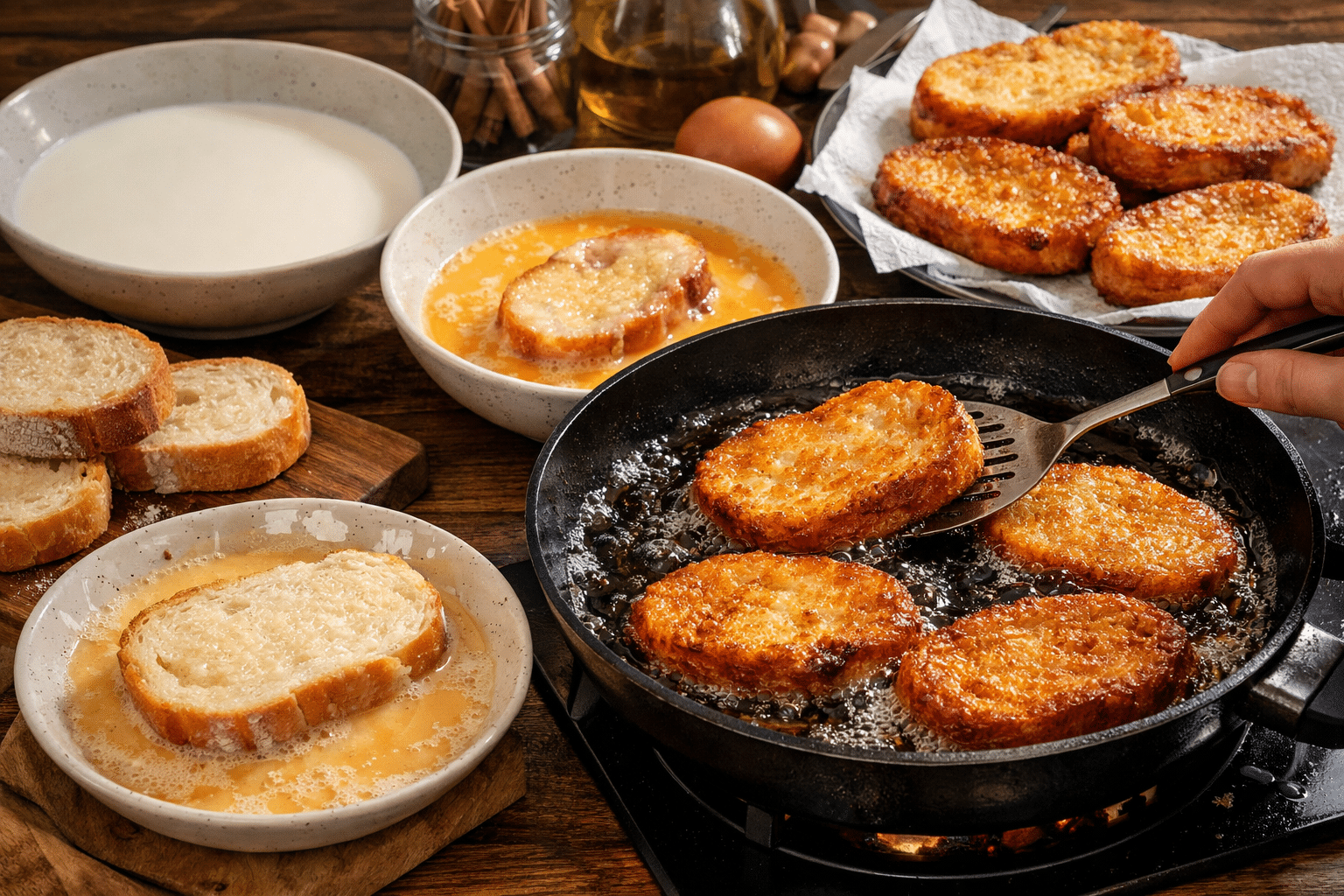
- Infusion: Heat the milk with the sugar, cinnamon stick and lemon peel. When it starts to boil, remove from the heat and let it infuse and cool. This is the secret of flavor.
- Soaking: Cut the bread into slices about 2 cm thick. Place them in a dish and pour the warm milk over them. Let them absorb the liquid until they are very heavy but do not break.
- Batter: Carefully dip each slice through the beaten egg, making sure they are tightly sealed.
- Frying: Fry in very hot oil until golden brown on both sides.
- Final Touch: Drain the excess oil on absorbent paper and, still hot, coat them in the sugar and cinnamon mixture.
4. Regional and modern variants
Spain is a mosaic of flavours, and each region brings its own personal touch to the torrija.
- Wine Torrijas (Andalusia and Castile): Instead of milk, the bread is soaked in sweet wine (such as Moscatel) or red wine diluted with water and sugar. They are richer and have a longer shelf life.
- Honey Torrijas (Madrid and Castilla-La Mancha): After frying them, they are bathed in a syrup made with honey and water (“enmeladas”). The result is a bright and extremely juicy torrija.
- Torrijas de Almíbar: Common in the south, where they are dipped in a light syrup flavored with aniseed.
- Modern Versions: In today’s Spanish haute cuisine, we find caramelized torrijas with a blowtorch (such as with Catalan cream), chocolate torrijas, or even savory versions with cheese and ham.
5. The Easter Torrija: The rhythm of tradition
Although today you can find Torrijas throughout the year in some specialised pastry shops in Madrid or Seville, its peak is Easter.
Consuming Torrijas at Easter is a social rite. Families get together to prepare them in large quantities, since, curiously, they are tastier the next day, when the sugar and milk have formed a natural syrup. In the processions, in the windows of century-old pastry shops and on the tables of every home, the Torrija is the undisputed queen. It is the dessert that marks the end of winter and the arrival of spring light in the Mediterranean and the interior of the peninsula.
A dream that is only lived in Spain
Torrija is more than a sweet; It is a complete sensory experience: the crunch of the first layer of sugar, the creaminess of infused bread and the aroma of cinnamon that evokes centuries of history. It is a genuinely Spanish delicacy that you can only savour at its best by living in Spain or enjoying your own residence in this country full of sun and culture.
If you’ve ever dreamed of waking up on a Spanish terrace with the scent of traditional pastries wafting through the air, it’s time to take the plunge. Check with SILC ESTATES now to see if you can find that dream home that makes you happy in Spain. Your new life, surrounded by traditions such as Torrijas, is waiting for you.