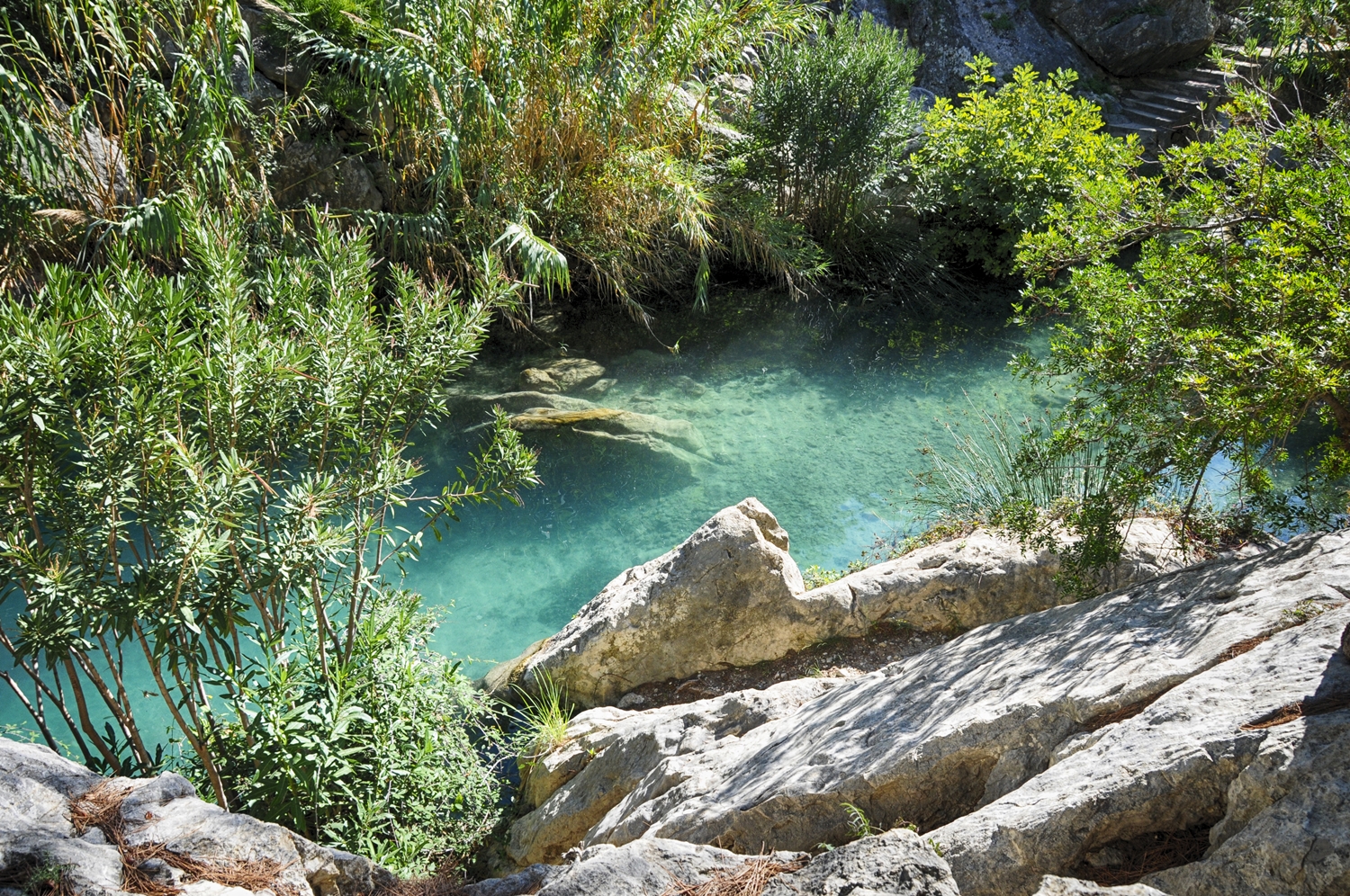
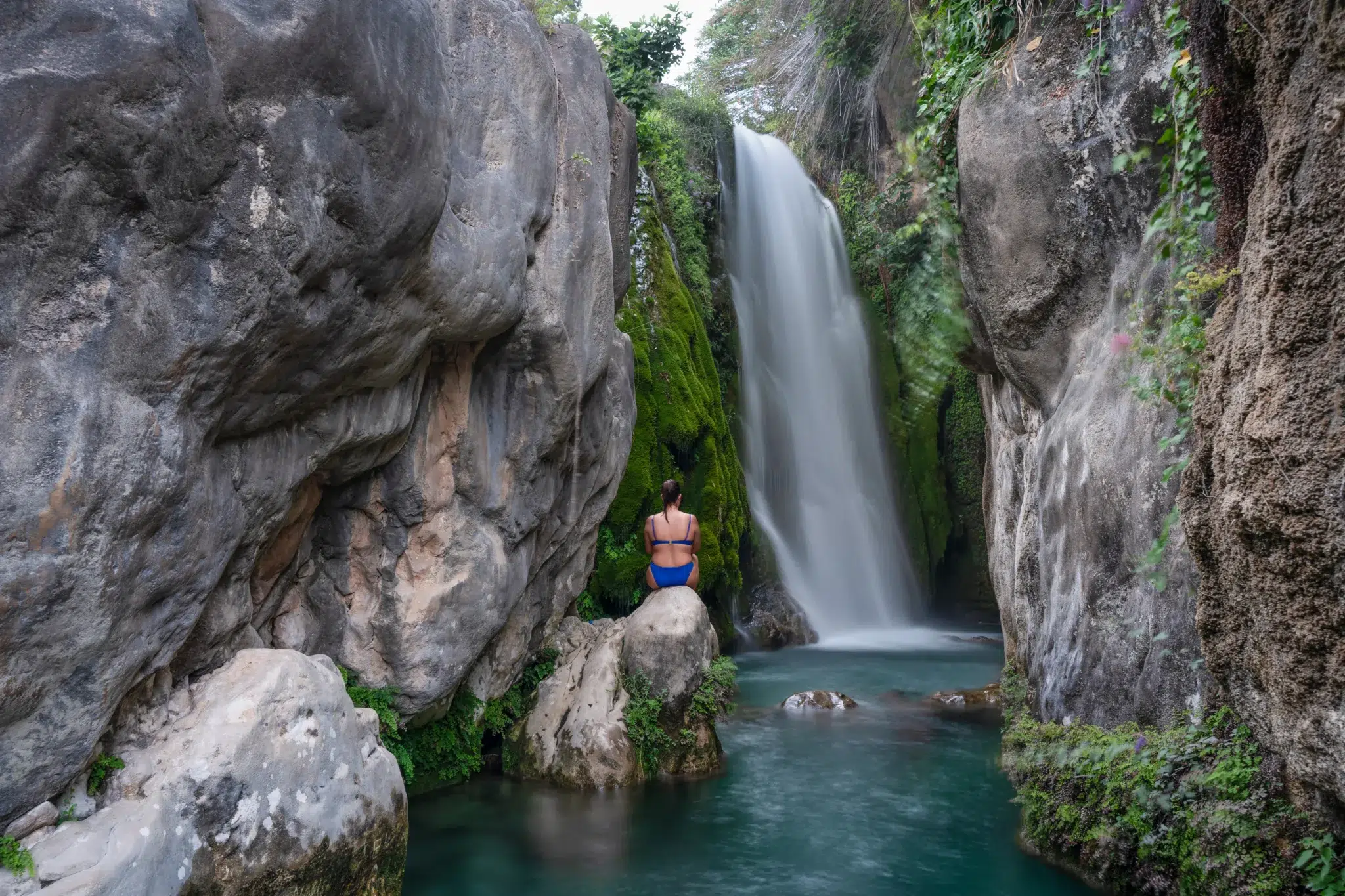
In the heart of the Marina Baja, just 15 kilometres from bustling Benidorm, an oasis emerges that seems to defy the aridity characteristic of the Spanish southeast. The Fuentes del Algar (Les Fonts de l’Algar in Valencian) are not only a natural site of exceptional beauty; they are the living testimony of the millenary relationship between water, geology and culture of the province of Alicante.
A Geological and Etymological Legacy
To understand the history of the Algar Springs, we must go back millions of years. The Algar River, whose name comes from the Arabic al-gar (meaning “the cave” or “the hollow”), is born from the filtration of rainwater in the limestone massifs of the Sierra de Bèrnia and the Sierra del Ferrer.
Unlike other Mediterranean rivers that suffer from severe low-water periods, the Algar benefits from a karst aquifer system. The limestone rock acts as a giant sponge that filters and stores water, releasing it constantly through tolls and waterfalls. This purity of the water, which is maintained at an average temperature of 17°C to 18°C, has been the engine of life in the area since time immemorial.
Water as an Engine of Civilization
Although today we know them as a tourist destination, for centuries the waterfalls were the pillar of the economy of Callosa d’en Sarrià.
- The Islamic Era: The Arabs, masters of hydraulic engineering, were the first to channel these waters systematically. They built ditches that made it possible to transform dry lands into fertile orchards, introducing crops that today are a hallmark of the area, such as loquats.
- The Loquat Revolution: Thanks to the abundance of water from the springs, Callosa d’en Sarrià became the main producer of loquats in Spain. The water of the Algar not only irrigated the fields, but also allowed the existence of a network of public washhouses and flour mills that took advantage of the force of the current.
- Traditional Use: Until the mid-twentieth century, the waterfalls were the place where women went to wash clothes and shepherds took cattle to water. It was not a place of leisure, but a center of work and survival.
The Birth of a Tourist Destination
The turn towards tourism began in the 70s and 80s. With the rise of Benidorm, visitors began to look for alternatives to the sun and the beach. The Algar waterfalls, with its cool microclimate and crystal clear waters, presented itself as the perfect getaway.
In 2002, the Valencian Government declared the area a Protected Wetland Zone. This was a historic milestone, as it meant the recognition of its ecological value and the need to regulate access to avoid degradation of the environment. Trails were established, native flora species were protected and the management of the site was professionalized.
A Tour of its Historical and Natural Landmarks
Today, the 1.5-kilometer route allows the visitor to be part of this history. When walking along its walkways, we find elements that narrate the past:
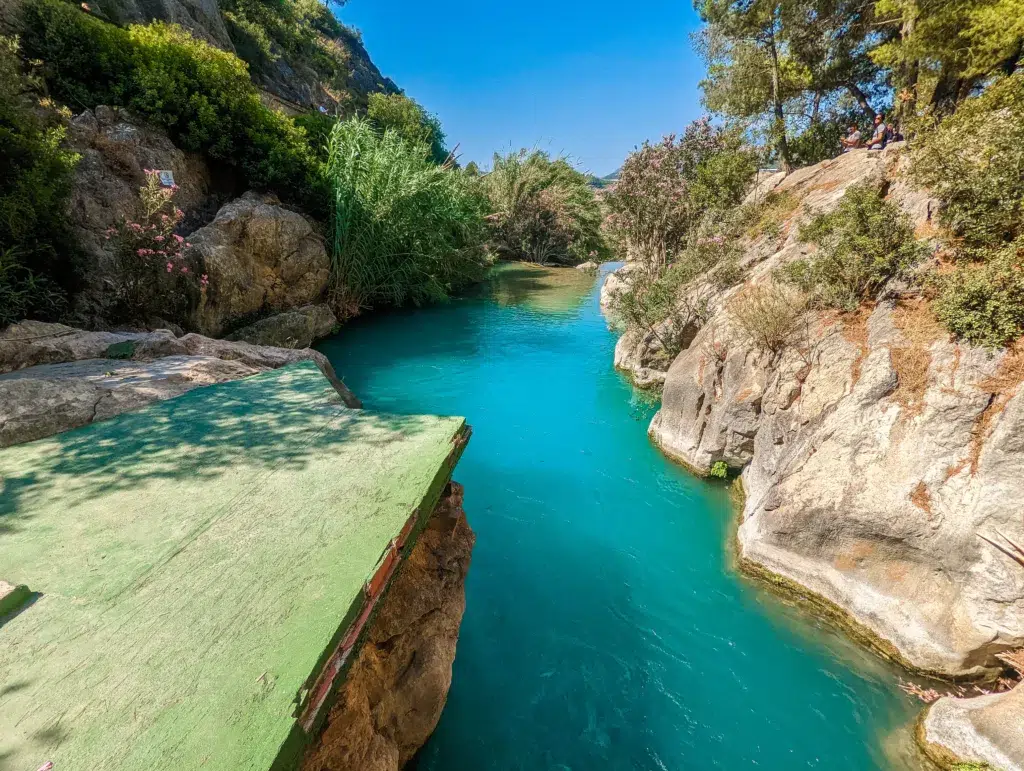
- The Toll of the Caldera: The main waterfall. Its force has eroded the rock for centuries, creating a deep pool that was once thought to be “bottomless.”
- The Toll of the Dam: An area where you can still see how the hand of man tried to tame the stream for irrigation.
- The Channel of Light: An impressive infrastructure that runs through the mountain and that once served to transport water to the hydroelectric plants in the area, illuminating the nearby villages when electricity was still a luxury.
Flora and Fauna: The Guardians of the Algar
The history of the waterfalls would not be complete without their non-human inhabitants. The environment is a stronghold of biodiversity:
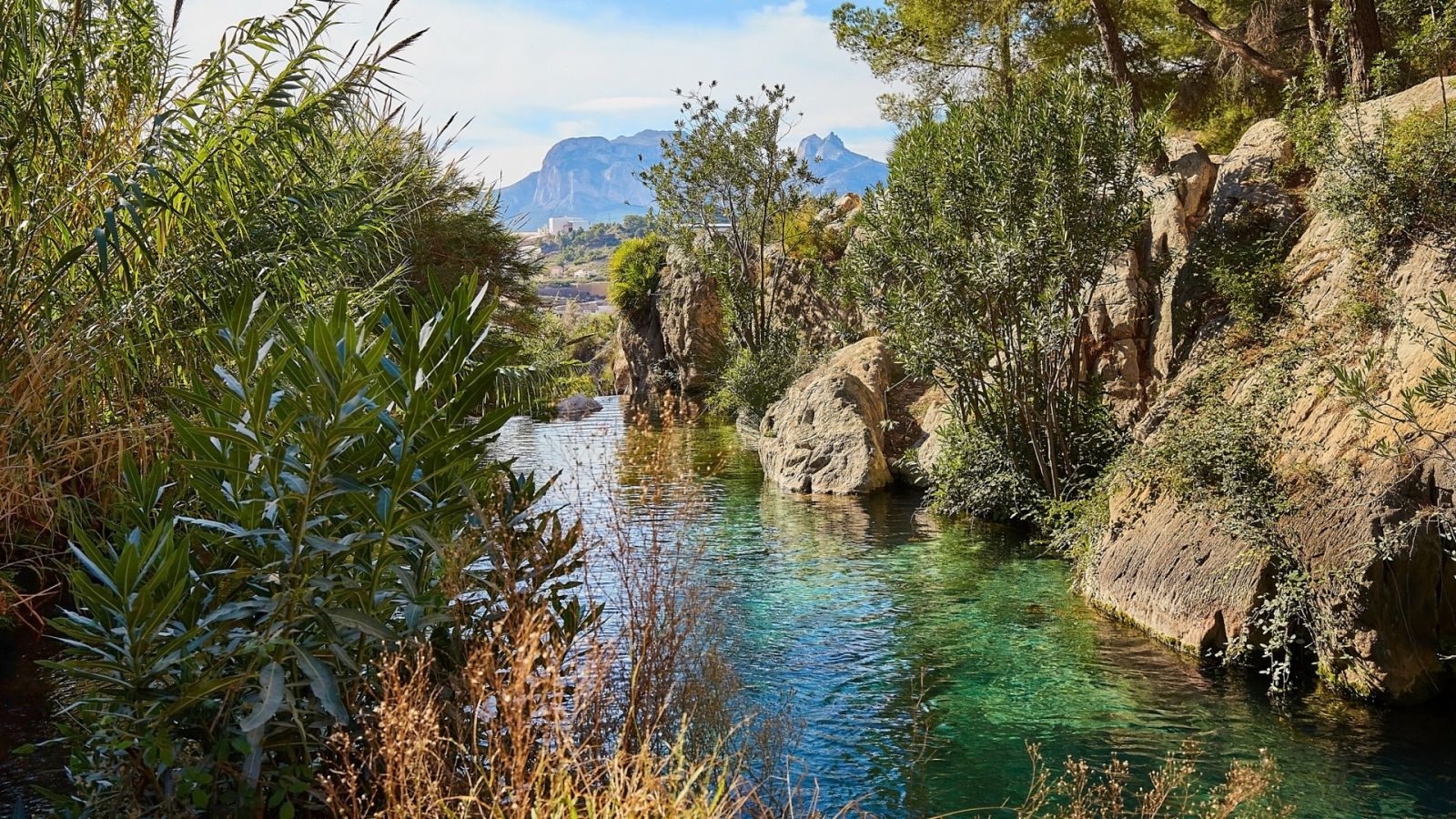
- Riverside vegetation: Oleanders, reeds, and poplar trees have flourished thanks to the constant humidity, creating a green tunnel that lowers the surrounding temperature by several degrees.
- Fauna: It is common to see grey herons, kingfishers and, in quieter areas, barbels and carp swimming oblivious to the murmur of tourists.
The Challenge of the 21st Century: Sustainability
Currently, the Fuentes del Algar face the challenge of dying of success. The current management focuses on sustainable tourism. Capacity control is strict, especially in summer, to ensure that human impact does not alter the quality of the water or the integrity of the rock formations.
The site also has the Water Museum and a botanical cactus garden (Arboretum), which complement the educational experience, teaching new generations that water is a finite and sacred resource in these lands.
The Fuentes de Algar are a true palimpsest, where you can read the geological history of Alicante, the agricultural ingenuity of the Arabs, and the evolution of modern tourism. Visiting this natural paradise is not only about immersing yourself in its icy, crystal-clear waters; it is about walking through a landscape that has sustained generations of people from Callosa d’en Sarrià and that continues to be the blue lung of the Marina Baixa region.
Note to traveler: If you decide to visit this historical treasure, remember that every stone and every drop of water has taken millennia to get there. Maintaining its purity is the best way to honor its history.
Do you want to know more secrets about the Fuentes de Algar?
The formation of the Algar waterfalls is a fascinating phenomenon that combines geology, chemistry and a privileged geographical location. Here we explain the details of this miracle of nature in the heart of the Costa Blanca.
1. How have the caves and relief been formed?
The formation of the caves and the landscape of the Algar is the result of a geological process called karstification.
- Limestone: The Bèrnia and Ferrer mountain ranges are mainly made up of limestone (calcium carbonate). This rock is hard, but it has a weakness: it is soluble in slightly acidic water.
- Natural acid rain: When it rains, the water absorbs CO₂ from the atmosphere and the soil, turning into a weak carbonic acid.
- Chemical Dissolution: This acidic water seeps through cracks in the rock. Over millions of years, the water “dissolves” the stone from within, widening the cracks into tunnels, galleries and eventually caves.
- The collapse and upwelling: In the case of the Algar, the water that circulates through these underground galleries finds an outlet to the surface due to the topography of the land, creating what we see today: a succession of fountains and waterfalls that have sculpted the outer rock.
How is there so much water so close to the sea?
It seems contradictory to find such a powerful flow in an area with a semi-arid climate and only 15 km from the coast. The key is in the orography and aquifers:
- Saw Screen Effect: The mountains surrounding Callosa d’en Sarrià (Sierra de Bèrnia, Aitana and Xortà) act as a barrier that traps the clouds that come from the sea. This causes more intense rainfall than on the coastline (orographic rainfall).
- The underground “reservoir”: The karst structure mentioned above works like a gigantic sponge. The mountains do not let water run to the surface and be quickly lost in the sea; instead, they absorb it and store it in deep underground aquifers.
- The Spring Emergence: Technically speaking, the Fuentes de Algar are a discharge point. Due to hydrostatic pressure and the inclination of the rock layers, the water accumulated in the mountains is forced to emerge at the surface precisely at this point before continuing its course toward its mouth in Altea.
Water Temperature: A Constant Challenge
If you’ve ever bathed there, you’ll know that the water is “chilly,” to say the least.
- Constant temperature: The water in the waterfalls is kept at an average temperature of between 17°C and 18°C throughout the year.
- Why does it not vary? As it is water that comes from deep underground aquifers, it is protected from thermal variations from the outside. The rock acts as a perfect thermal insulator.
- In summer: It feels icy because the contrast with the 35°C outside is brutal.
- In winter: Interestingly, water can feel “less cold” than outside air, although it still maintains its 17°C.
This temperature is ideal for maintaining oxygenation of the water and the local aquatic life, although for the average swimmer it usually requires a little courage before the first dip.
The Algar waterfalls are much more than just a bathing place; They are a natural theme park that offers a different experience depending on the time of year. For those of us who live on the Costa Blanca, this place is a luxury of proximity that allows you to break with the routine of “sand and salt”.
Most common activities
The design of the site allows people of all ages to find something to do:
- Swimming in “Tolls” (Pools): It is the star activity. The channel offers areas of different depths. There are pools where it barely covers 40 cm (ideal for children) and other deeper ones, such as the Toll de la Caldera, where the bravest usually make jumps from the rocks (always under the supervision of lifeguards in season).
- Scenic Route (gentle hiking): There is a 1.5 km signposted route that runs along the river. It is a visually striking walk where you cross wooden bridges, walk along water channels and contemplate the various waterfalls.
- Visit to the Arboretum: In the upper part of the enclosure is this botanical garden that houses a wide variety of Mediterranean plants and cacti, ideal for lovers of botany.
- Local Gastronomy: In the vicinity there are 5 restaurants specialising in local cuisine. It is almost mandatory to try the dishes made with loquat from Callosa, which has a Designation of Origin.
- Canyoning: In the permitted areas and with specialized guides, you can practice water canyoning, descending through the natural waterfalls and slides that the river has carved in the stone.
Why enjoy it every year if you are a resident?
Living on the Costa Blanca gives us the privilege of enjoying the Algar waterfalls in their different facets, beyond the overcrowding of the summer:
- Thermal shelter: In July and August, when the humidity of the coast becomes suffocating, the microclimate of the Algar (a few degrees lower than on the beach and water at 18°C) is the best natural “air conditioning” in the province.
- The Rain Show (Autumn/Spring): If you live nearby, you can visit after a few days of heavy rainfall. That is when the river reveals its wildest and most powerful side; the roar of the waterfalls becomes thunderous, and the visual spectacle of the springs bursting forth is something that a one-time tourist rarely gets the chance to witness.
- Peace in “Low Season”: Between October and May, the place is transformed into a place of meditation and silent strolling. It’s the ideal time for photographers and those looking for hiking without the queues of the high season. In addition, at this time of year access is allowed with pets (leashed), something prohibited in summer.
- Proximity to other treasures: As residents, we can use the waterfalls as a starting point for longer routes, such as climbing the Fort of Bèrnia or visiting the village of Guadalest, completing an inland day that has nothing to do with the coast.
- Environmental Education for Children: It is a place that changes with the seasons. Taking the children every year helps them understand the water cycle and the value of water resources in an area as dry as ours.
Local Council: If you live in the area, try to go on a Tuesday or Wednesday in June or September. You will have paradise practically to yourself, with the perfect temperature and all the infrastructure (lifeguards and services) operational.