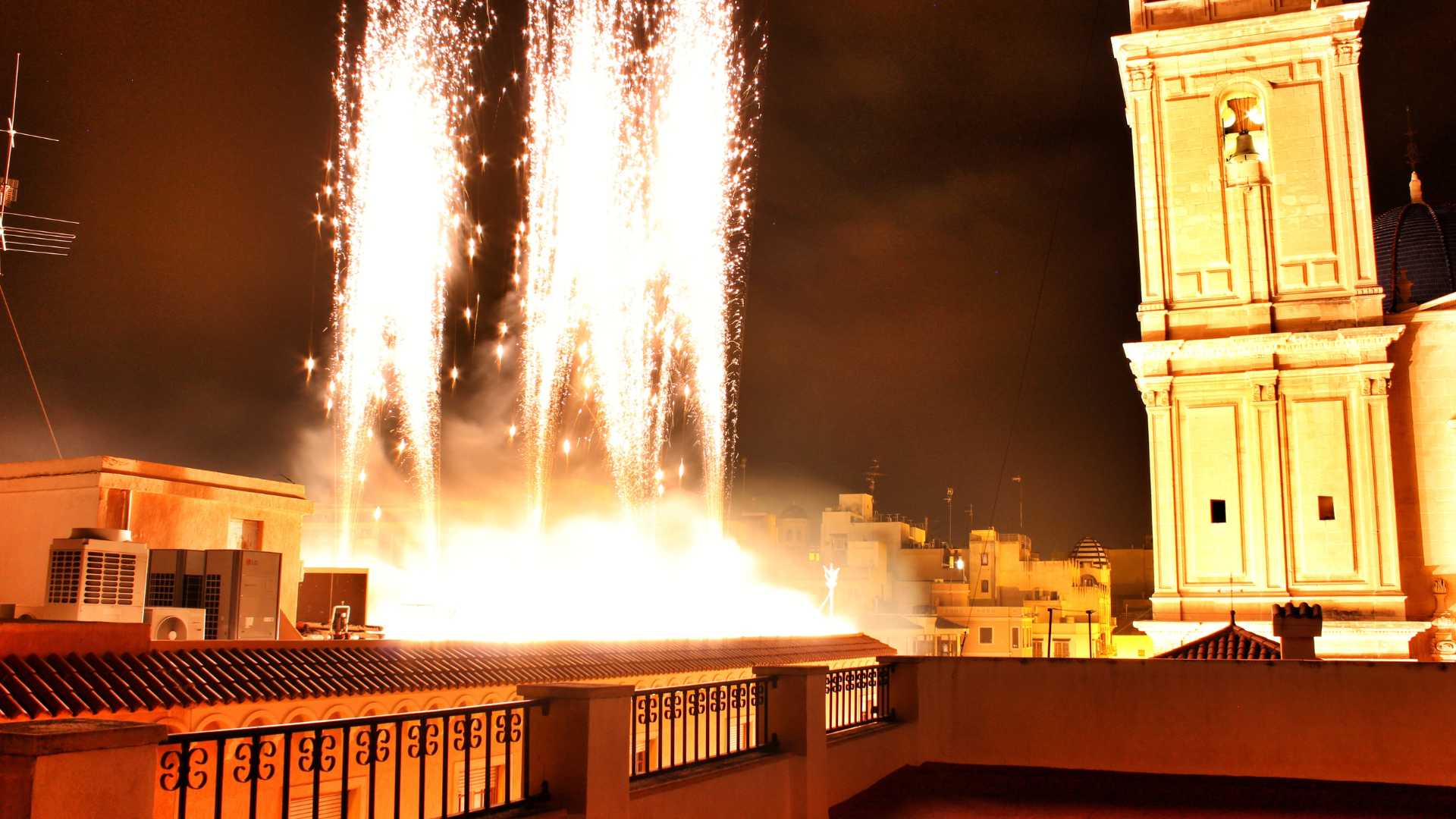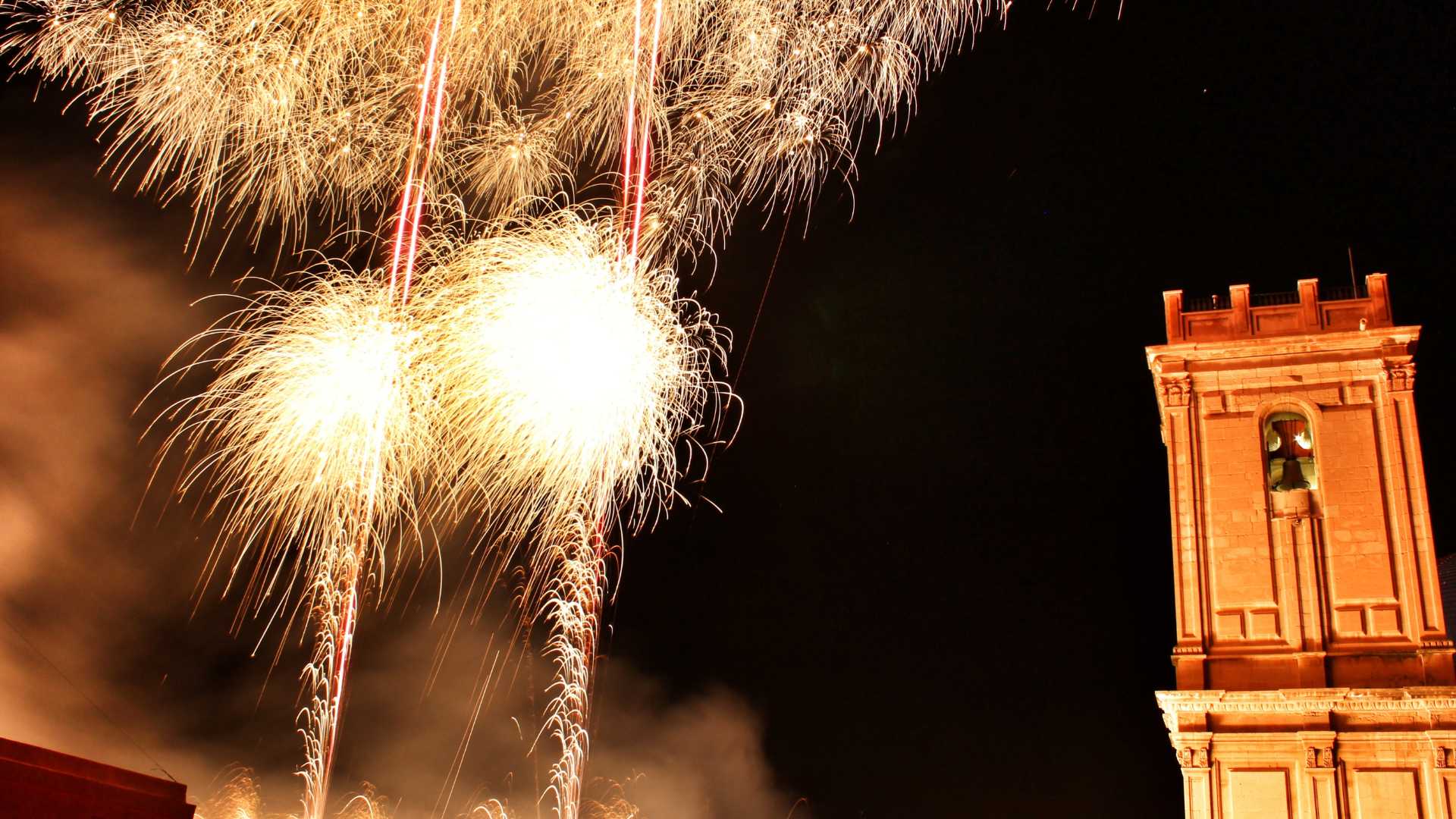
The night of 13 August is no ordinary night in the calendar of the Valencian Community, and even less so in the heart of the province of Alicante. It is the night when Elche (Elx) challenges the darkness and transforms its sky into a blazing canvas. La Nit de l’Albà, which translates as the Night of the Dawn, is far more than a fireworks display; it is a collective ritual, a demonstration of devotion, a thunderous celebration of gunpowder and one of the most impressive cultural events in all of Spain, officially recognised as a Festival of National Tourist Interest.
To understand the scale of this event, you need to forget the traditional idea of a conventional fireworks display. During La Nit de l’Albà, there is no single launch site where spectators simply stand and watch. Here, the entire city is simultaneously the stage, the protagonist and the audience. From terraces, rooftops, bridges and open spaces, fireworks rise into the sky in a coordinated barrage that culminates in one of the most breathtaking moments a visitor can experience: the legendary Palmera de la Virgen.
This article will immerse you in the rich history of this centuries-old tradition, explore how it has evolved into the colossal event it is today and, most importantly, provide you with a practical and detailed guide so that, if you are not an Elche resident and are planning to travel from a nearby city such as Alicante, you will know exactly where to go, how to get there and how to experience the event like a true ilicitano (someone from Elche).
The Historical Roots: An Origin Linked to the Misteri
To discover the origins of La Nit de l’Albà, we need to travel back several centuries to the Middle Ages. The history of Elche and its August festivities is inseparably linked to the city’s greatest cultural treasure: the Misteri d’Elx (Mystery Play of Elche), a medieval sacred musical drama depicting the Dormition, Assumption and Coronation of the Virgin Mary, recognised by UNESCO as a Masterpiece of the Oral and Intangible Heritage of Humanity.
In the days leading up to the performance of the Misteri, the city would already begin to come alive with excitement. Historical documents suggest that, as was customary throughout Mediterranean lands, religious celebrations were accompanied by popular expressions of joy. The use of gunpowder, inherited from the profound influence of Islamic culture on the Iberian Peninsula and deeply rooted in eastern Spain, became the perfect way to express this collective jubilation.
Originally, the people of Elche spontaneously launched rockets into the sky in honour of the Virgin of the Assumption, the city’s patron saint. There was a deeply spiritual and familial motivation behind this act: many families bought and launched their own rockets as an offering or in memory of loved ones who had passed away. Each explosion in the sky was a prayer, a memory, a name spoken in light. It is this emotional connection that distinguishes La Nit de l’Albà from any commercial fireworks display; the fire has a soul.
Over time, wealthier families began to compete amicably to see who could offer the largest and brightest firework, laying the foundations for what is now the sponsorship system for the palmeras, in which individuals and companies finance parts of the display.
The Evolution of Fire: From Paper Lanterns to a Canopy of Light
La Nit de l’Albà has not always resembled the technologically advanced and meticulously timed spectacle we see today. Its current format is the result of constant evolution.
At the beginning of the 20th century, the celebration was much more modest in terms of firepower, but no less charming. A fascinating record of this period can be found in the work of Elche-born painter Salvador Sánchez Braceli, who captured the festive sky on canvas in 1924. At that time, the launching of the palmeras was often accompanied by illuminated paper lanterns released into the sky, floating slowly overhead and creating a magical, almost melancholic atmosphere very different from the explosive intensity of today.
As the pyrotechnics industry advanced, so too did the city’s ambitions. In recent decades, Elche City Council, working alongside the region’s leading pyrotechnics companies and with the invaluable support of local residents, began to orchestrate the chaos. What had once been a free and unstructured launching of fireworks gradually became a coordinated and choreographed display.
Today, the spectacle is meticulously structured. For approximately 45 minutes, more than 300 firework palms are launched from various strategic points around the city, creating a relentless crossfire that envelops Elche in a continuous roar and a multicoloured glow.
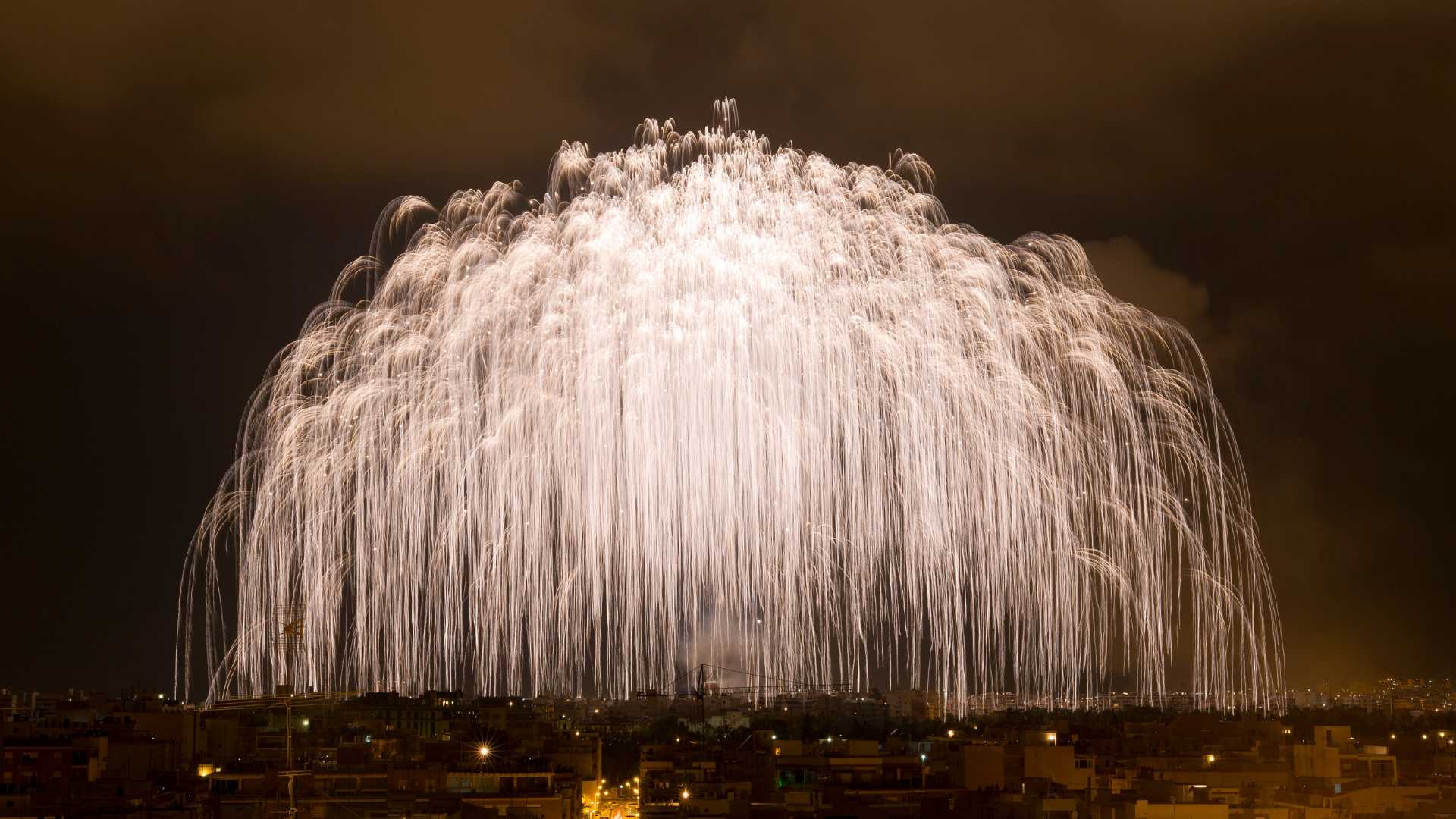
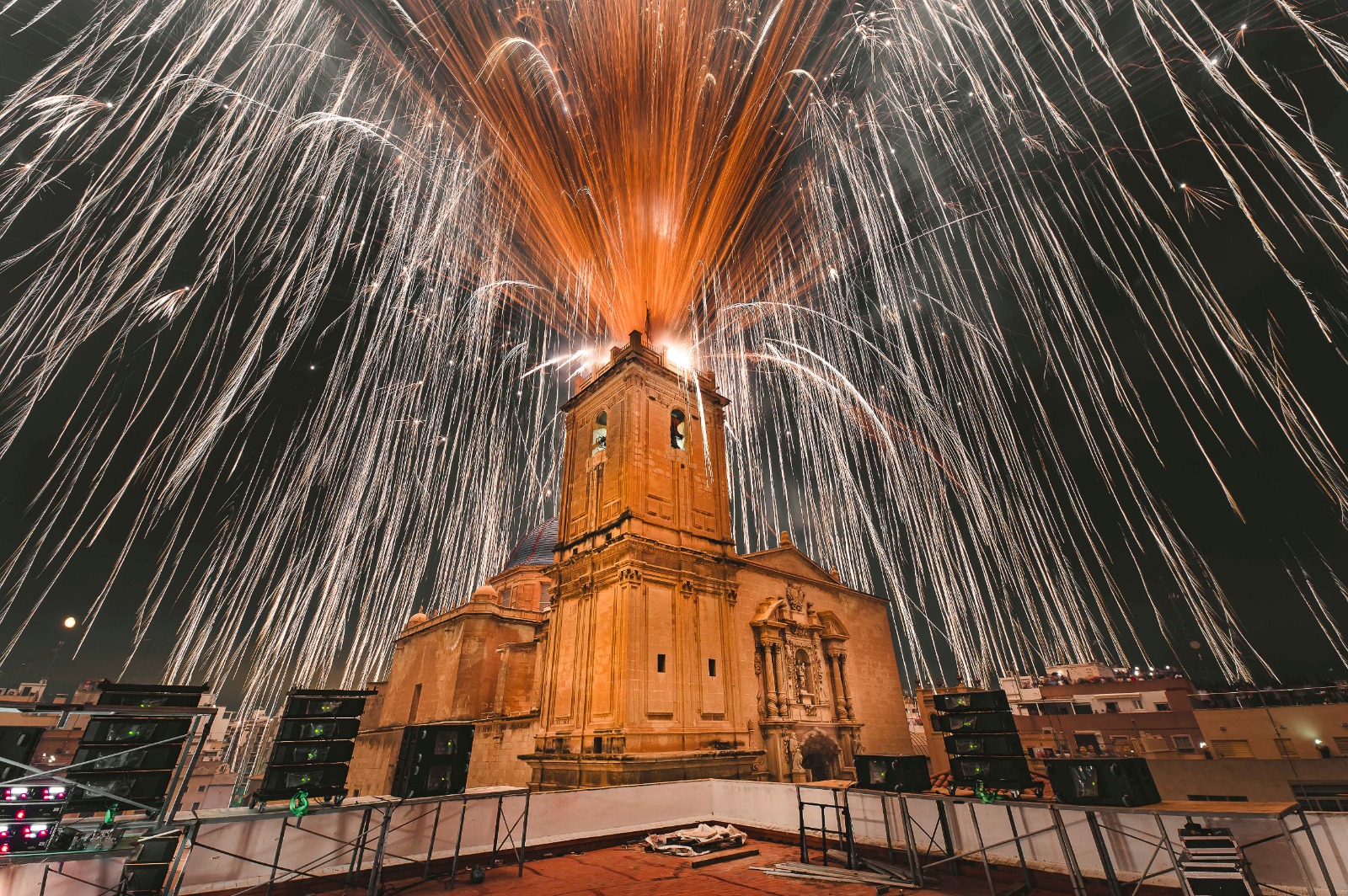
The climax of this evolution is undoubtedly the Palmera de la Virgen. What was once a large rocket has become a feat of pyrotechnic engineering. At exactly midnight, following several minutes of complete darkness throughout the city that plunge the crowds into expectant silence, a monumental palm-shaped firework is launched from the bell tower of the Basilica of Santa María. It reaches a height of 300 metres and opens across a radius of 700 metres. For a few magical seconds, night becomes day as an immense dome of pure white light completely covers the city centre. It can be seen from dozens of kilometres away, from places such as Santa Pola and even Alicante itself.
After the explosion, the smoke slowly disperses and, high on the bell tower, a metal structure illuminated with flares forms the silhouette of the city’s patron saint. This is when another of the night’s most moving moments takes place: from balconies, rooftops and streets, thousands of voices sing the habanera “Aromas Ilicitanos” in unison. And to bring such an intense celebration to a refreshing close, tradition calls for eating watermelon, a custom that remains very much alive in homes and gatherings throughout the city.
The Best Places to Watch (If You’re Not a Resident)
The biggest challenge for visitors coming to Elche on the night of 13 August is finding the right place to watch. Elche residents generally enjoy La Nit de l’Albà from the private terraces and rooftops of their buildings, often gathering for family dinners before the display. If you are visiting from elsewhere and are not lucky enough to have access to an unobstructed rooftop, the city offers some excellent public viewpoints where you can enjoy every moment.
Here are the best options for watching the spectacle
1. Pont del Bimil·lenari
This modern bridge, with its imposing cable-stayed structure, is probably the best panoramic viewpoint in the city. Slightly elevated and spanning the riverbed, it provides a clear and unobstructed line of sight towards the historic centre and the Basilica. From here, you can appreciate not only the Palmera de la Virgen in all its glory, but also the simultaneous launch of hundreds of smaller palmeras from different neighbourhoods such as Altabix, Carrús and Sector V. Arriving well in advance is highly recommended if you want to secure a good spot.
2. The Vinalopó Riverbed
The Vinalopó River runs through Elche, leaving a wide riverbed that serves as an enormous pedestrian corridor. This is undoubtedly one of the most popular and festive places for visitors and groups of friends. Although it can become very busy, its sheer size allows thousands of people to gather comfortably. The atmosphere is vibrant; spectators often bring folding chairs, picnic-style dinners and, of course, the traditional watermelon to enjoy when midnight arrives. Visibility is excellent along the sections closest to the central bridges.
3. Pont de la Generalitat
Another excellent option overlooking the riverbed. Like the Pont del Bimil·lenari, it offers a wide perspective, although locals point out that visibility from here can depend on the atmospheric conditions that particular evening, such as wind direction and the accumulation of smoke. Nevertheless, it remains a privileged viewing point.
4. Wide Avenues (Avenida de la Comunidad Valenciana)
For those who would rather avoid the largest crowds in the city centre or along the riverbed, finding a spot on one of the wide avenues on the outskirts, such as Avenida de la Comunidad Valenciana, is a sensible alternative. You will not be right at the epicentre of the thunderous noise, but you will still have an unobstructed view of the domes of light illuminating the city.
An important safety note: After the Palmera de la Virgen comes the Carretillada. In a specially designated and enclosed area, local carretilleros, protected by thick fire-resistant clothing and protective mesh, take part in the mass launching of carretillas, flying and ground-level firecrackers. It is an intense and spectacular tradition, but one strictly reserved for those wearing the appropriate protective clothing. If you are visiting the city as a tourist, stay outside the designated perimeter so that you can enjoy the festivities safely.
Logistics and Transport: How to Get There from Alicante
La Nit de l’Albà brings the city to a standstill, in the best possible way. If you are planning to travel to Elche that afternoon or evening, careful planning is absolutely essential if you want to avoid traffic jams and parking frustrations.
Cercanías Commuter Train (The Most Recommended Option)
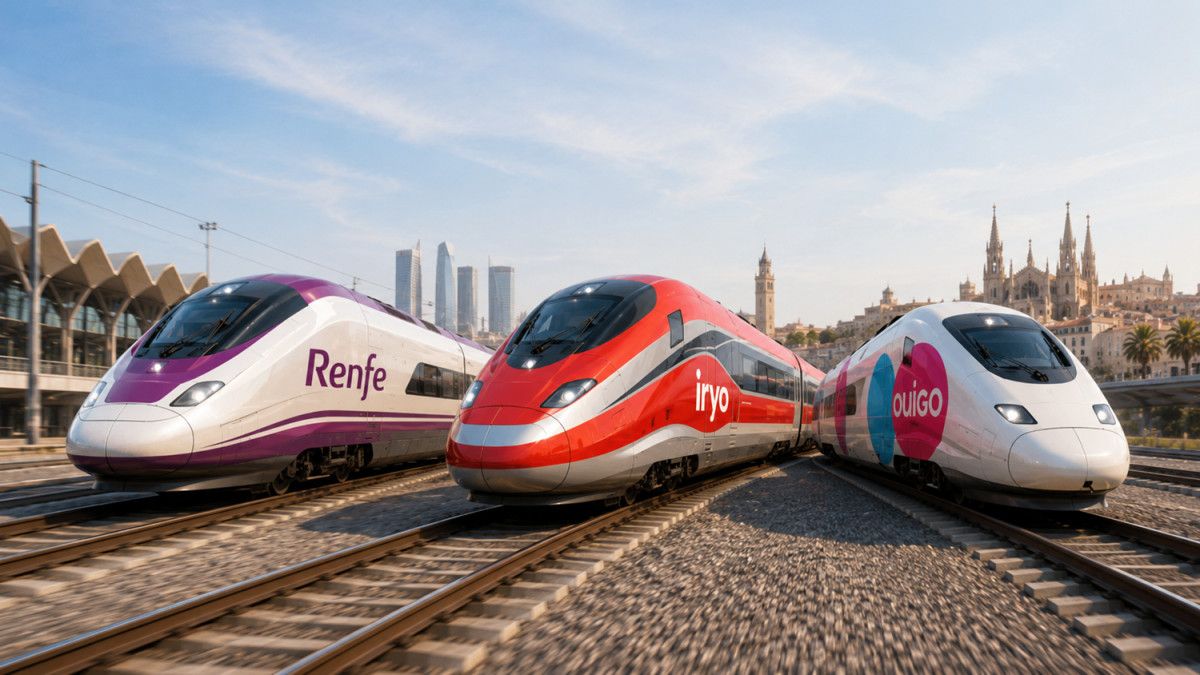
Without a doubt, the train is by far the best option for this journey. Renfe’s C-1 Cercanías line connects Alicante Terminal station directly with Elche, offering a comfortable and convenient journey that takes approximately 30–40 minutes depending on the stops.
What makes the Cercanías train particularly convenient is that it takes you directly to Elx Parc (Elche Parque) station. As soon as you leave the station, you are opposite the Municipal Park and only a few minutes’ walk from the historic centre, the Vinalopó River and the Basilica of Santa María, in other words, right in the heart of the festivities.
Renfe is very aware of the huge influx of passengers on this date and traditionally puts special arrangements in place. They usually provide double-unit trains (doubling the number of available seats) for the key evening departures from Alicante, as well as special return trains in the early hours of the morning. For example, return services are usually scheduled after 1:00 a.m. (01:10 from Elx Parc), allowing visitors to enjoy the Palmera de la Virgen, eat their watermelon at leisure and return to Alicante without having to take the car.
Practical tip: Buy your return tickets well in advance, or arrive at Alicante station with plenty of time to spare, as passenger numbers are extremely high that afternoon.
Travelling by car
If, for whatever reason, you need to travel by car, be prepared to be patient. The journey from Alicante via the A-7/A-70 motorway or the N-340 national road normally takes around 25–30 minutes, but traffic increases considerably during the afternoon of 13 August.
The main challenge is not the journey itself but parking. Elche’s historic centre and many surrounding streets are closed to traffic for safety reasons, and central public car parks fill up very quickly.
The golden rule if you are travelling by car is to park on the outskirts and walk into the centre. The most recommended areas are:
- Miguel Hernández University (UMH) campus: Located in the north of the city, there is usually parking available in the surrounding area, and it is a pleasant 15–20-minute walk to the Vinalopó riverbed.
- Altabix neighbourhood (newer areas): Close to the Martínez Valero Stadium. You will have a slightly longer walk to reach the central viewing areas, but getting back onto the motorway towards Alicante in the early hours will be infinitely easier.
Intercity Bus
Although there are bus services between Alicante and Elche, they tend to be the least attractive option on this particular night. Buses can suffer the same traffic delays as private vehicles, while late-night timetables generally do not offer the same flexibility or capacity as the special Cercanías train services.
Conclusion: A Night That Stays With You
La Nit de l’Albà is not an event you simply watch; it is something you physically feel. The vibration in the air with every palmera, the unmistakable smell of burnt gunpowder filling the streets, the warmth of an August night and the collective sense of awe as the Palmera de la Virgen tears through the dark sky combine to create a deeply sensory and emotional experience.
For the people of Elche, it is a night to reconnect with their roots and with the memory of those who came before them. For visitors, it is a unique opportunity to witness the power of a tradition that has managed to preserve its medieval origins while embracing the grandeur of the present day.
If you are in Alicante or the surrounding area on 13 August, don’t miss the opportunity. Take the C-1 Cercanías train, find a good spot near the Pont del Bimil·lenari or the Vinalopó River, look up at the sky and discover why, for a few magical minutes, Elche can boast one of the loudest, brightest and most beautiful skies in the world. And remember to round off the evening with the sweet, refreshing taste of a good slice of watermelon.
Would you like to experience this event every year? Are you thinking of buying a summer home in Spain or retiring there? Contact our property experts at SILC ESTATES today.