
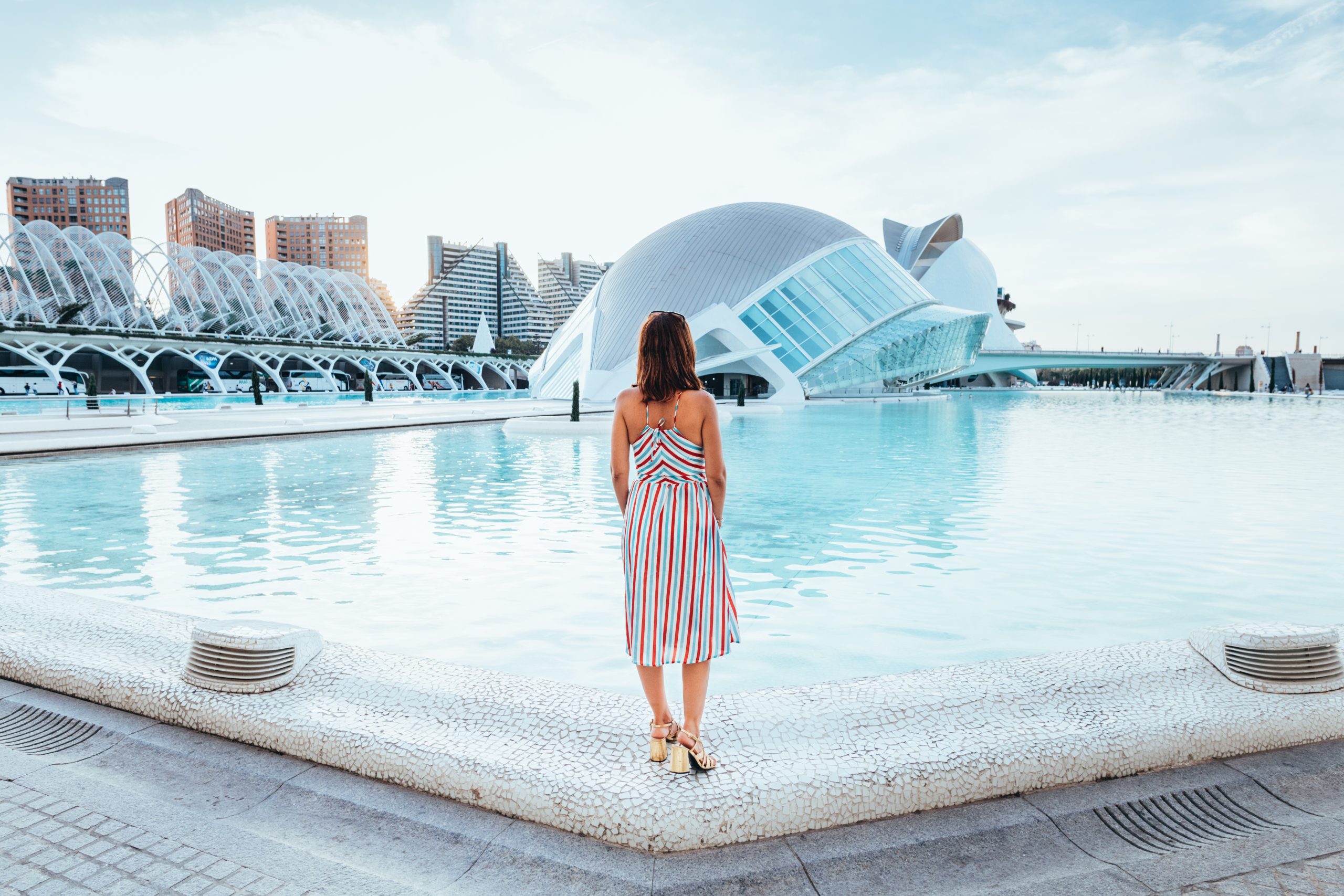
The City of Arts and Sciences (CAC) is not only the modern symbol of Valencia; It is one of the most important scientific and cultural dissemination complexes in the world. Located at the end of the old Turia riverbed, this “city within a city” seems to have landed from the future to stay in the hearts of Valencians.
Below, we thoroughly explore this architectural colossus, its history, its secrets and the ultimate guide to not missing anything.
1. The Origin: From the River to the Stars
The history of the CAC begins with a tragedy that changed Valencia: the Great Flood of 1957. After the Turia overflowed, the river was diverted to the south of the city, leaving a dry bed of 7 kilometers that crossed the center.
At the end of the 80s, the then president of the Generalitat, Joan Lerma, embraced the idea of creating a scientific centre. The project was commissioned to the Valencian architect Santiago Calatrava, who would later be joined by Félix Candela for the design of the Oceanogràfic.
Evolution and Openings
- 1998: L’Hemisfèric, the first piece of the puzzle, is inaugurated.
- 2000: The Príncipe Felipe Science Museum opens its doors.
- 2003: The Oceanogràfic, the largest aquarium in Europe, is inaugurated.
- 2005: The Palau de les Arts Reina Sofía completes the cultural offer.
- 2009: The bridge of l’Assut de l’Or and the Agora (now CaixaForum) are completed.
Although the project faced criticism for its cost overruns, today it is the city’s number one tourist engine, attracting millions of visitors annually.
2. Anatomy of the City: What to see and do?
The complex is divided into six main structures, each with a distinct purpose and personality.
A. L’Hemisfèric: The Eye of Wisdom
It is the most iconic building, designed to look like a human eye opening onto a 24,000 $m^2$ artificial lake.
- What’s inside? A dome projection room with IMAX technology, 3D digital cinema and astronomical projections.
- What to do? Watch a documentary about the cosmos, nature, or history. The experience is immersive thanks to its 900-square-meter concave screen.
- Estimated time: 1.5 hours (including entry and duration of the film).
B. Science Museum: Do Not Touch
Under a structure reminiscent of the skeleton of a cetacean, this museum breaks with the idea of “looking and not touching”.
- What’s inside? Three floors of interactive exhibits. From the “Street of Science” to the impressive section on DNA and space.
- What to do? Participate in “Science on Stage” workshops, watch the chicks hatch in the incubator live or experiment with gravity.
- Estimated time: 3 to 4 hours. If you’re a science enthusiast, you could spend the whole day.
C. L’Oceanogràfic: A Journey Through the Oceans
Designed by Félix Candela, its water lily-shaped roof is a masterpiece of organic architecture. It is the largest aquarium in Europe.
- What’s inside? Representations of the main ecosystems of the planet: Arctic (with beluga whales), Antarctic (penguins), Tropical, Red Sea and the spectacular shark tunnel.
- What to do? Walk under the sharks, watch the educational show at the dolphinarium, and marvel at the 26-meter-high aviary.
- Estimated time: 4 to 5 hours. It is the space that requires the most time due to its length and the schedules of the shows.
D. Palau de les Arts: The Avant-garde Opera
A majestic building more than 70 meters high dedicated to the performing arts.
- What’s inside? Four large halls: the Main Hall, the Master Room, the Amphitheatre and the Martín y Soler Theatre.
- What to do? Attend an opera, classical music concert, or ballet. If there are no performances, there are guided tours to learn about its acoustic engineering.
- Estimated time: 1 hour (guided tour) or 3 hours (if you attend a function).
E. L’Umbracle: The Garden of Eden
A landscaped viewpoint promenade with plant species typical of the Mediterranean area and contemporary sculptures.
- What’s inside? The Sculpture Walk and a garden full of palm trees, bougainvillea and rosemary. In summer, part of the enclosure becomes a night terrace.
- What to do? It is the best place to take panoramic photos of the entire complex. Admission is free.
- Estimated time: 30 to 45 minutes.
F. CaixaForum (Former Agora)
The most recent structure to be revitalized. A versatile space that now hosts world-class art exhibitions.
- What’s inside? A cultural center with temporary exhibitions, auditorium and educational spaces.
- What to do? Enjoy the interior architecture, which looks like a metal whale, and visit the exhibition on duty.
- Estimated time: 1.5 to 2 hours.
3. Timing and Planning Guide
If you want to see it all, you need at least two full days. Trying to compress it into a single day is possible but exhausting and will force you to see things superficially.
Option 1: The intense day (10-12 hours)
- Morning (10:00): Oceanogràfic (it is the one that gets the most crowded, better to go early).
- Lunch: Eat in the resort’s dining areas or at the nearby Aqua Shopping Center.
- Afternoon (15:00): Science Museum.
- Sunset (18:00): Walk along the Umbracle and photo on the bridge of l’Assut de l’Or.
- Evening (19:00 or 20:00): Screening at the Hemisfèric to rest your feet.
Option 2: The relaxed weekend
- Day 1: Spend the morning at the Oceanogràfic and the afternoon take a walk through the gardens and watch a film at the Hemisfèric.
- Day 2: Explore the Science Museum at your leisure and visit the CaixaForum or take a tour of the Palau de les Arts.
4. Curiosities that few know
- The Echo Effect: In the entrance arches of the Science Museum, if two people stand at opposite ends of an arch (about 50 meters away) and one whispers, the other will hear it perfectly thanks to the acoustics of the structure.
- Seawater: The water of the Oceanogràfic is brought directly from the coast of the Malvarrosa, complying with strict filtering and quality controls.
- Hollywood Set: The CAC has been the setting for films such as Tomorrowland (with George Clooney) and series such as Doctor Who and Westworld, due to its futuristic aesthetics.
5. Practical Tips for the Visitor
- Combined Tickets: Do not buy single tickets. Combined tickets (Museum + Hemisfèric + Oceanogràfic) are much cheaper and are valid for 1 to 3 days.
- Footwear: You’re going to walk a lot on concrete and white tiles. Comfortable shoes are mandatory.
- Sun Protection: In summer, the reflection of the sun on the white of the buildings and the water is very intense. Sunglasses and sunscreen are essential.
- Transportation: Line 10 of the Metrovalencia has a stop called “Ciutat Arts i Ciències – Justícia” that leaves you right in front of it.
The City of Arts and Sciences is a testament to how a city can reinvent itself through architecture and knowledge. Whether it’s the spectacular nature of the Oceanogràfic tunnels or the mathematical perfection of the curves of Calatrava, it’s a visit that leaves its mark.


