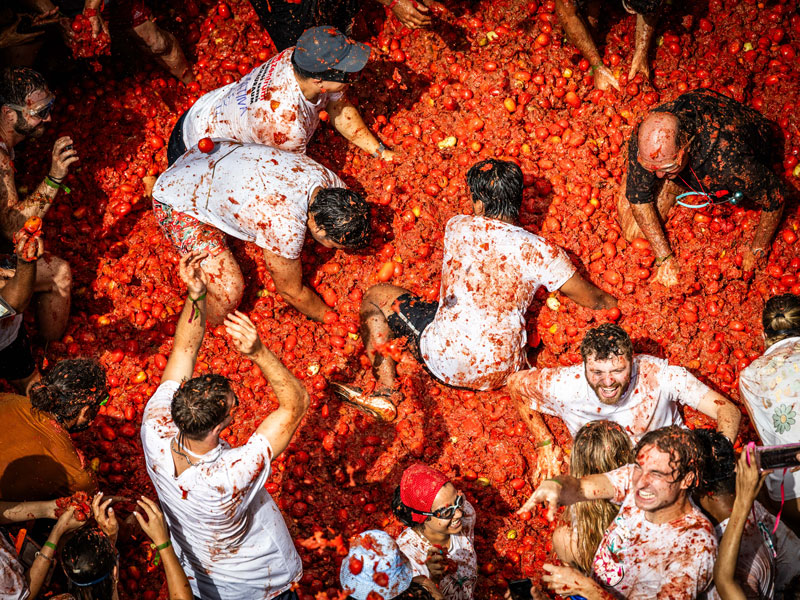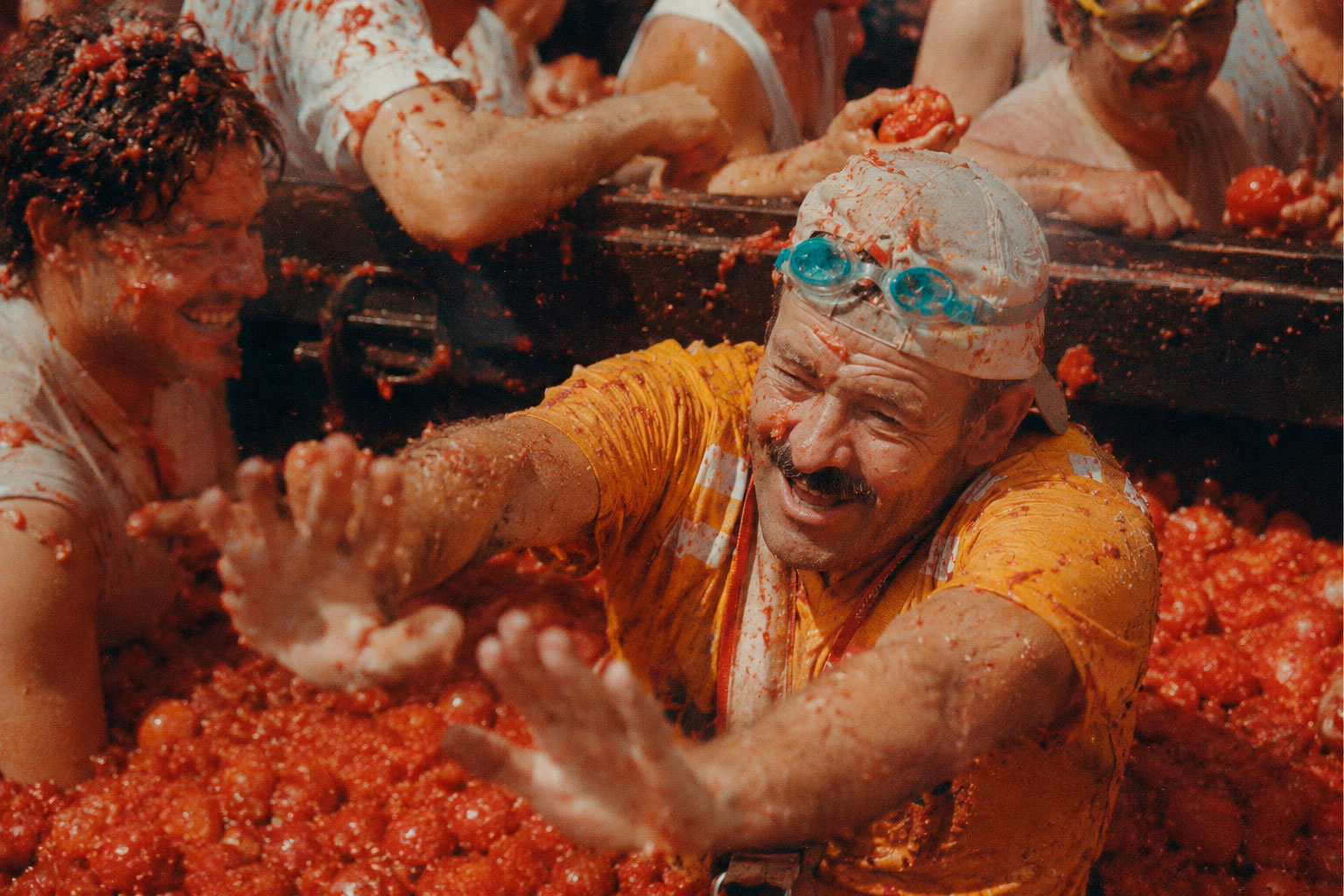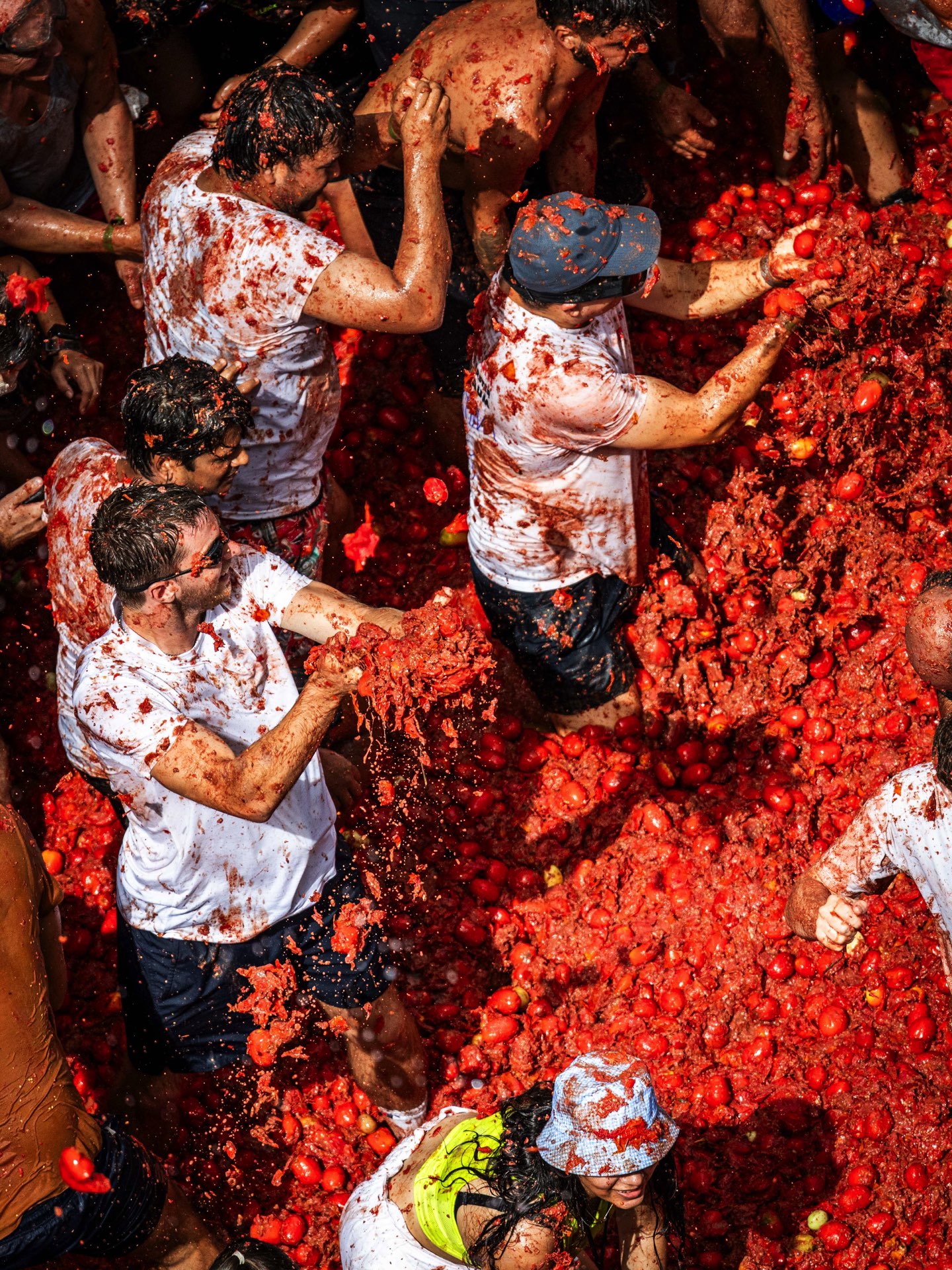
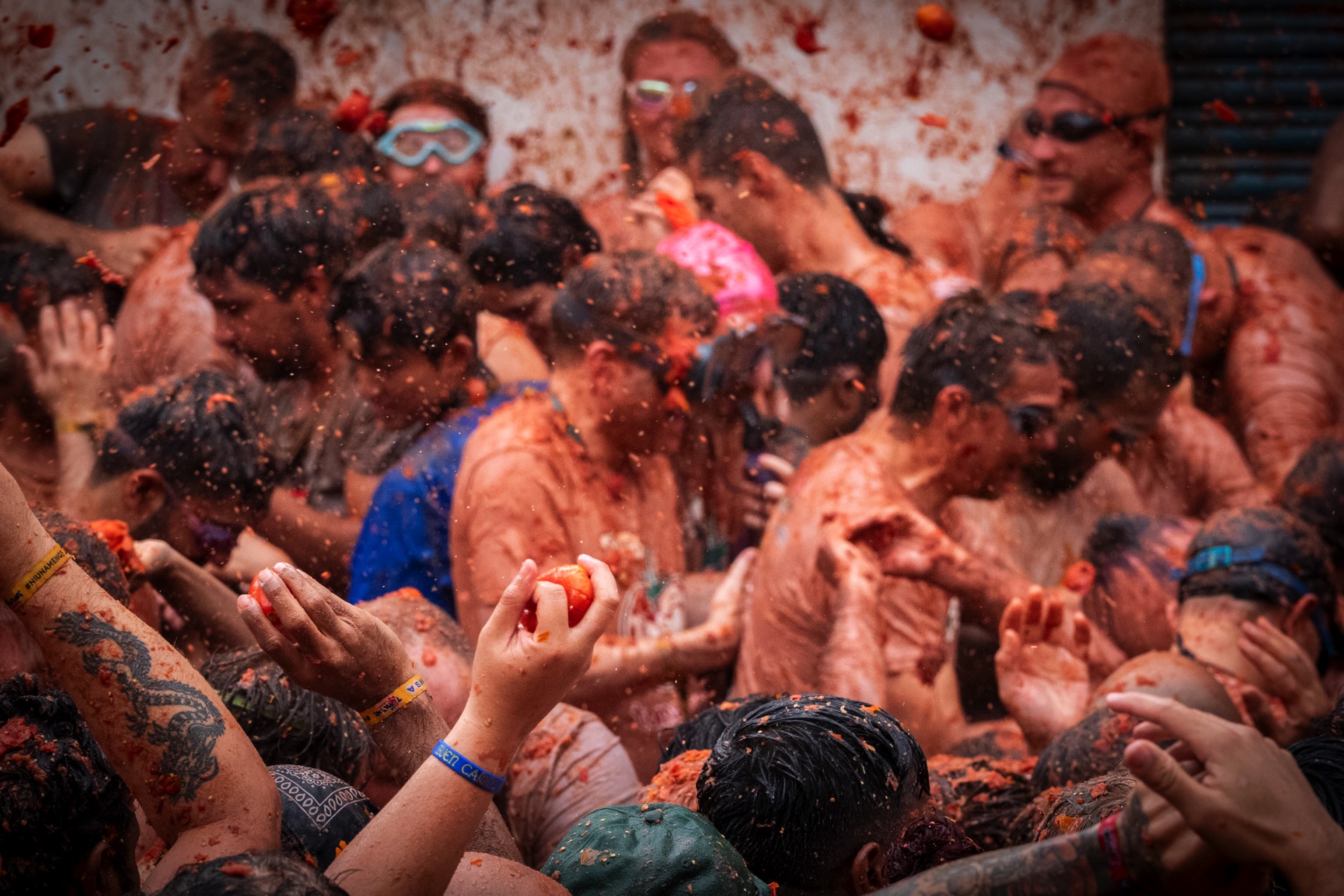
La Tomatina takes place every year on the last Wednesday of August, from 12 noon to 1.00 pm, in the Valencian town of Buñol. For sixty exhilarating minutes, the streets of the historic centre are transformed into a surging red river where joy, fun and adrenaline bring together visitors from around the world in a festive experience unlike anything else.
Recognised as a Festival of International Tourist Interest in 2002, La Tomatina is much more than a huge vegetable fight. It is a living testament to popular mischief, local resistance to post-war censorship and the ability of a small Valencian community to turn a street incident into one of Spain’s most internationally recognisable cultural and tourist phenomena. Below is a comprehensive guide to its history, the official ticketing system, the rituals of the battle, additional experiences and the essential rules of conduct and safety.
1. Key Event Information
- When is La Tomatina held? Every year on the last Wednesday of August.
- Battle time. From 12 noon to 1.00 pm (an official duration of exactly 60 minutes).
- Location. Central streets (Calle Cid and Calle San Luis) and Plaza del Pueblo in Buñol (Valencia), a town located around 40 km west of the city of Valencia.
- Tomatoes. Around 120 tonnes (120,000 kilos) of ripe tomatoes are expected to be used for the 2026 edition.
- Venue capacity. Strictly limited to 22,000 attendees (in 2026) with an official ticket and identification wristband.
- Official information and ticket sales. The official
latomatina.infowebsite.
2. The Complete History and Evolution of La Tomatina (Since 1945)
To understand the scale La Tomatina has reached today, we need to go back eight decades to Spain in the mid-1940s, a period marked by the hardships of the post-war years, when creativity and a sense of humour provided a welcome form of escape.
The Chance and Accidental Beginnings of 1945
La Tomatina was born on the last Wednesday of August 1945 in Buñol’s Plaza del Pueblo. The town was celebrating the main days of its patron saint festivities in honour of San Luis Bertrán and the Virgen de los Desamparados. During the traditional and crowded parade of gigantes y cabezudos, giant figures and people wearing oversized papier-mâché heads, a group of young men from Buñol, caught up in the festive atmosphere and eager to stand out from the crowd, tried to push their way into the official procession.
Their excessive enthusiasm accidentally caused one of the participants dressed as a cabezudo to fall over. When he got back to his feet, visibly furious about the fall and the crowd’s mockery, the man began shouting at and attacking anyone who crossed his path. By chance, a street vegetable stall from the local market happened to be right next to the commotion. Finding themselves cornered, the young men began grabbing tomatoes from the stall’s wooden crates and throwing them at the man in self-defence.
Within seconds, the surrounding crowd was swept up in the scuffle and people began throwing tomatoes at one another in a spontaneous vegetable battle. The brawl ended with the intervention of the authorities and payment to the stallholder for the ruined tomatoes, but the spark of fun had already caught hold in the town.
The Years of Secrecy, Fines and Resistance (1946–1956)
The following year, on the last Wednesday of August 1946, the same young men met once again in Plaza del Pueblo at the same time, but with one significant difference: this time, they brought the tomatoes from their own homes. What had begun as an accident was becoming a voluntary and deliberate event.
The 1950s were a critical period for the survival of the tradition. The celebration had no official authorisation and was viewed with suspicion by the Franco regime and the municipal authorities, who regarded it as a disturbance of public order with no religious, political or patriotic basis.
In the early 1950s, La Tomatina was strictly prohibited. Those who defied the ban and took to the streets with tomatoes were dispersed, fined and even taken to police stations. Nevertheless, the complicity of local residents and the determination of groups of young people meant that the battle was recreated year after year, in an ongoing game of cat and mouse with the local police.
1957: The Historic “Burial of the Tomato” and the Triumph of Ingenuity
The defining moment that ultimately saved the festival from extinction came in 1957. Following yet another strict ban imposed by the local council, the people of Buñol decided to respond not with violence, but with a demonstration filled with irony and popular satire: the legendary Entierro del Tomate, or “Burial of the Tomato”.
A huge funeral procession, with participants dressed from head to toe in solemn mourning clothes, made its way through Buñol’s main streets carrying a wooden coffin on their shoulders, inside which lay an enormous tomato. Behind the coffin marched the band of the Sociedad Musical La Artística, playing solemn funeral marches, surrounded by women and men pretending to weep inconsolably over the “death” of their beloved tradition.
The demonstration was so ingenious, peaceful and unanimous that it completely disarmed the authorities. Buñol Town Council acknowledged the will of the people and legalised La Tomatina, officially incorporating it into the programme of the town’s August patron saint festivities.
The Television Impact of Javier Basilio on Informe Semanal (1983)
Despite its local recognition, for almost three decades La Tomatina remained a secret known mainly to residents of the Hoya de Buñol area and the province of Valencia. Its great leap onto the national stage came in 1983, when the legendary Spanish Television programme Informe Semanal broadcast a report by journalist Javier Basilio.
The images of an entire town submerged in a tide of red euphoria, combined with Basilio’s eloquent narration highlighting the civic spirit with which residents cleaned the façades and streets after the battle, made an enormous impact across Spain. Following the broadcast, thousands of young people from all over the Iberian Peninsula began travelling to Buñol on the last Wednesday of every August, marking the beginning of mass tourism to the town.
International Expansion and Recognition in 2002
With the arrival of the digital age and the globalisation of telecommunications in the late 1990s, photographs of Buñol flooded with tomatoes travelled around the world, appearing on the front pages of major international newspapers and on television networks such as the BBC, CNN and Japan’s NHK.
In 2002, the Spanish Government’s General Secretariat for Tourism officially awarded La Tomatina the status of Festival of International Tourist Interest, placing it on the same level of prominence as events such as the San Fermín festival in Pamplona and Las Fallas in Valencia.
The Introduction of Controlled Capacity and Increased Safety (2013–Present)
Its overwhelming global fame brought with it the challenge of overcrowding. In the 2012 edition, more than 50,000 people packed into Buñol’s historic centre, in a town with an official population of barely 9,000 inhabitants, creating clear risks for evacuation and the emergency services.
Faced with this situation, in 2013 Buñol Town Council took the pioneering decision to introduce a capacity limit and establish an official ticketing system. This measure not only improved the physical safety of participants and residents, but also raised the organisational standards of the event, allowing for additional safety, security and support services.
3. The Official Ammunition: Tonnes of Tomatoes
One of the subjects that generates the greatest interest and debate surrounding La Tomatina is the origin, type and environmental impact of the projectiles used during the sixty-minute festival.
- Origin and volume. For the 2026 edition, around 120 tonnes (120,000 kilograms) of ripe tomatoes are expected to be used.
- Selection of the pear tomato variety. Pear tomatoes (Solanum lycopersicum) are used. This variety is distinguished by its elongated shape, thin skin, very juicy flesh and soft consistency when ripe, characteristics that help reduce the risk of injury when the tomatoes strike participants.
- Circular economy and agricultural use. The tomatoes destined for La Tomatina do not enter the commercial supply chain for household or supermarket consumption. They are agricultural surpluses that do not meet the requirements for size, shape or acidity demanded for sale as fresh produce. Using them for the festival prevents these batches from being discarded and left to rot in the fields, while providing Spanish farmers with a direct financial return on a crop that would otherwise be unprofitable.
- Cleaning properties of citric acid. Far from permanently staining the streets, tomato juice contains a high concentration of natural citric acid. Once the festival is over and municipal cleaning teams spray the roads and façades with high-pressure water, the citric acid acts as a natural cleaning agent, helping to remove accumulated dirt from the stone paving and leaving it remarkably clean.
4. Ticket Prices, Packages and Available Services
To pass through the access controls and take part in La Tomatina, participants must purchase an official ticket in advance through the authorised latomatina.info website.
Ticket Types and Official Prices
- Single Entry Ticket (Municipal Access Fee): €15
- Provides access exclusively to the fenced and secured area where the tomato battle takes place.
- Issued digitally as a Print at Home ticket (a downloadable PDF that can either be printed or displayed on a smartphone).
- Includes exchange for the official identification wristband at the designated checkpoints in the town.
- Intended for people who have their own accommodation in Buñol or neighbouring towns and do not require any additional services.
- Basic Package from the Buñol Association of Traders and Self-Employed Workers: from €40
- Includes the official Buñol Town Council admission fee (valued at €15).
- Includes the official commemorative La Tomatina T-shirt.
- Includes use of the supervised cloakroom and luggage storage service for backpacks, dry clothes, keys and documents during the festival.
- Includes a full portion of traditional Valencian paella cooked over a wood fire, plus a cold drink after the event.
- After-Party and Full Festival Package: from €50 to €65
- Includes all the services in the basic package (official admission, cloakroom, commemorative T-shirt, plate of paella and a drink).
- Includes admission to the official post-Tomatina party area, with stages, professional lighting and continuous DJ sessions.
- Includes vouchers for additional drinks (beer, sangria or soft drinks) and festive accessories.
- Tourist Packages with Organised Transport: from €75 to €110
- Official ticket with guaranteed access wristband.
- Direct return transport by air-conditioned coach from strategic locations in Valencia city, such as the bus station or city centre, as well as options from Madrid or Barcelona.
- Assistance from multilingual tour guides throughout the journey and travel insurance.
Compulsory Wristband Exchange Procedure
- The digital ticket is only proof of purchase. The PDF document containing the QR code received by email does not provide direct access to the battle area.
- Validation times and locations. On the day of La Tomatina, wristband exchange points located around the entrances to the town open from 9.00 am. Staff scan the code and fit the official wristband.
- Access control. Only people wearing the official wristband, securely fitted around their wrist, will be allowed through the police cordon and into Calle Cid and Plaza del Pueblo.
Administrative Procedure for Travel Agencies
Travel agencies and tour operators organising groups must apply for ticket allocations through the official Electronic Office of Buñol Town Council. Municipal regulations stipulate:
- A minimum allocation of 20 tickets and a maximum of 1,800 tickets per application.
- A strict period of 15 calendar days following provisional allocation in which to pay the fees. If payment is not made within this period, the reservation automatically lapses.
- Compulsory submission of the travel agency licence and a certificate confirming registration for Spain’s Economic Activities Tax (IAE).
5. Event-Day Schedule: Minute by Minute
La Tomatina follows a carefully organised programme designed to coordinate the enjoyment of thousands of people while ensuring maximum logistical safety.
- 9.00 am: Access controls open and morning entertainment begins. The booths for exchanging tickets for official wristbands open. The town fills with music, lively street bands and the aroma of pumpkin fritters as thousands of participants dressed in white converge on the centre.
- 10.00 am to 11.45 am: The “Palo Jabón” ritual. A wooden pole several metres high is erected in Plaza del Pueblo and generously coated with industrial grease or soap, with a cured ham hanging from the top. Hundreds of participants attempt to climb it, forming elaborate human towers and slipping amid laughter, while local residents throw buckets of water from balconies and terraces. Whoever manages to reach the top and untie the ham gets to take it home as a trophy.
- 12 noon: First firework (official start of the battle). A powerful firework launched from the Town Hall echoes through the Buñol valley. At the same time, six large lorries loaded with tomatoes slowly enter the route. Workers begin unloading and throwing the tomatoes, unleashing an uninterrupted red tide of joy and collective adrenaline.
- 12 noon to 1.00 pm: The hour-long battle. For sixty minutes, the road surface disappears beneath a thick layer of tomato juice and pulp. People of all cultures and backgrounds come together in festive chants and a continuous barrage of tomatoes, in an atmosphere of universal camaraderie.
- 1.00 pm: Second firework (absolute ceasefire). A second pyrotechnic explosion marks the exact end of the battle. Tomato throwing stops immediately. Anyone who throws a tomato after this signal is reprimanded and removed by security personnel.
- From 1.15 pm onwards: Cleaning, showers and socialising. Buñol residents bring their hoses out into the streets to cool down and rinse off participants, the public showers provided by the council are opened, and the food areas begin serving giant paellas while open-air concerts get under way.
6. Other Experiences, Culture and Tourism in Buñol
A visit to Buñol for La Tomatina can be complemented by a wide range of cultural, family and heritage attractions.
- La Tomatina Infantil. Held on the Saturday before the main festival in Plaza del Pueblo, this is a completely free version designed specifically for children aged between 4 and 14. It takes place within a fenced-off area, uses specially selected extra-soft tomatoes, has supervisors on hand and lasts between 30 and 40 minutes, allowing younger visitors to discover the festival in a safe, family-friendly environment.
- La Tomatina Museum at Molino de Galán. Located in a restored former paper-making industrial complex, this interactive museum is open throughout the year. It features an immersive room with 270-degree audiovisual projections, Virtual Reality (VR) stations that recreate the experience of riding on a tomato lorry, augmented reality applications featuring the official mascot “Tico”, and a historical collection of posters, documents and photographs dating back to the 1950s.
- Historic Monuments and Nature Trails. Buñol is home to the imposing Buñol Castle, a 13th-century medieval fortress built on a rocky hill with panoramic views across the surrounding area. A short distance from the town centre lies the Cueva del Turche natural area, a geological beauty spot with a lake and a 60-metre waterfall surrounded by Mediterranean vegetation, perfect for relaxing after the intensity of the festivities.
7. Practical Advice for Participants
To enjoy La Tomatina comfortably and without unnecessary problems, it is worth keeping these basic recommendations firmly in mind.
- Old or white clothing. Tradition dictates wearing white to emphasise the visual contrast with the intense red of the tomatoes. Wear very old clothes, such as a T-shirt and shorts, that you can throw away after the festival, as the smell and tomato stains can be difficult to remove completely.
- Secure, closed footwear. Wear old trainers, securely fastened with double knots. Flip-flops, sandals, clogs and other open footwear are strongly discouraged, as they can come off very easily in the tomato pulp and leave your feet unprotected from being stepped on or from slipping.
- Swimming or diving goggles. These are highly recommended. Tomato juice contains citric acid, which can cause considerable stinging if it gets into your eyes. Well-fitting swimming goggles will allow you to see clearly throughout the battle and enjoy the festival without eye irritation.
- Protect cameras and phones. If you decide to take your mobile phone or camera to capture the moment, always keep it inside a certified watertight protective case, preferably worn around your neck and tucked underneath your T-shirt.
- Tickets and wristband exchange. Purchase your pass only through the official
latomatina.infochannels and arrive in Buñol with plenty of time to exchange it for your wristband before the battle begins. - A clean change of clothes. Pack a towel, dry clothes and clean footwear in a backpack so that you can change after showering, and leave it in the designated storage facilities or in the boot of your car.
8. Rules of Conduct and Safety Protocols
The success and continued existence of La Tomatina depend on absolute respect for a number of basic safety and civic rules.
- Always squash tomatoes before throwing them. This is the festival’s golden rule. Never throw a whole, hard tomato. It must first be crushed in your hand so that it hits as a soft, harmless pulp.
- Hard objects are strictly prohibited. Participants may not carry or throw glass bottles, drinks cans, sticks, stones or any other hard objects that could cause injury.
- Respect other people’s clothing. Tearing, ripping or pulling other participants’ T-shirts is strictly prohibited.
- Keep a safe distance from the lorries. The six lorries carrying the “ammunition” move very slowly through narrow streets packed with people. It is essential to stay away from the wheels and never cross their path.
- Stop immediately when the second firework sounds. When the pyrotechnic signal sounds at 1.00 pm, nobody should throw another tomato.
- Safe spaces and Puntos Violeta. The event has trained staff, information tents and security personnel in place to prevent and respond immediately to any sexual harassment or sexist aggression.
9. Transport and Travel Guide to Buñol
Buñol has excellent transport links with the city of Valencia, both by public transport and by road.
- Renfe Cercanías commuter train (Line C-3). This connects Valencia-Nord and València-Sant Isidre stations with Buñol station, with a journey time of approximately 45 to 50 minutes. For La Tomatina, Renfe provides additional train services from early in the morning.
- Buses and organised trips. Regular bus services operate from Valencia’s Central Bus Station, in addition to numerous organised private coach excursions that include admission and direct transport.
- Travelling by car (A-3 motorway). Buñol lies on the A-3 motorway (Madrid-Valencia). Anyone travelling by private car should set off early and arrive in the town before 7.30 am, when the security services begin closing the town centre to road traffic and the outlying park-and-ride areas reach maximum capacity.
Conclusions
Experiencing La Tomatina in Buñol is one of those unforgettable experiences that everyone should enjoy at least once in their lifetime. Beyond the visual spectacle and the adrenaline rush of plunging into a red tide of shared laughter, this festival embodies the purest essence of the Mediterranean character: spontaneous joy, hospitality and the extraordinary ability to bring together visitors from every corner of the world in a shared spirit of friendship and peaceful celebration.
For those who would like to enjoy this legendary celebration year after year, along with the endless cultural, gastronomic and scenic attractions of eastern Spain, owning a home in Spain offers an incomparable advantage. Making your home on the Costa Blanca provides the perfect balance between the tranquillity of its dreamlike beaches, an exceptional climate throughout the year and fast, direct connections to iconic destinations such as Buñol and the vibrant city of Valencia. If you dream of enjoying the Mediterranean lifestyle or investing in a property that allows you to experience unique traditions such as this at close hand, contacting SILC ESTATES is the best way to find your dream home in Spain with complete confidence and expert property advice.